

Frances Widdowson faced mob hostility for saying unmarked graves have yet to be proven
Dr. Frances Widdowson’s visit to Winnipeg on Sept. 25 and 26 should have been an opportunity for debate. Instead, the city’s universities endorsed a statement that undermines academic freedom.
Widdowson, a political scientist known for questioning official narratives about residential schools, came to meet students who wanted to ask about claims of “unmarked graves.” Those claims, which became national headlines in 2021 after ground-penetrating radar surveys at former school sites, remain unproven because no physical evidence of burials has been found.
For many Canadians, the claims of“unmarked graves” were a shocking revelation, given how widely the story was reported as a settled fact.
That context alone should have been enough to spark discussion. Instead, the University of Manitoba and the University of Winnipeg joined the Assembly of Manitoba Chiefs in issuing a statement that should embarrass both schools. At institutions dedicated to study and inquiry, the instinct should be to ask more questions, not to shut them down.
At first, the statement sounded reasonable. It said the universities did not “condone violence or threats to anyone’s safety.” But that did not stop Widdowson from being roughed up by a mob at the University of Winnipeg. It would be refreshing if the universities condemned mob violence with the same urgency they condemned a professor answering questions. Their silence sends its own message about which kind of behaviour is tolerated on campus.
The bigger problem is the statement’s claim that there is a single “truth” about residential schools, known to “survivors,” and that questioning it amounts to “denial.” In reality, 143 residential schools operated with federal support for more than a century. What happened varied widely from place to place and decade to decade.
That is a subject for historical research, grounded in evidence and debate, not pronouncements about capital-T “Truth” issued by communications offices. Canadians deserve to know that history is still being studied, not declared untouchable.
Worse still was the statement’s promise to “press the Government of Canada to enact legislation that makes residential school denialism a crime.” The Assembly of Manitoba Chiefs is free to say what it wants. But universities lending their names to a demand that historical inquiry be criminalized is beyond misguided; it is dangerous.
Criminalizing “denialism” would mean that even challenging details of the residential school record could be punishable by law. Canadians should think carefully before accepting laws that turn historical debate into a criminal offence.
The University of Chicago’s widely praised statement on academic freedom puts it well: “the University’s fundamental commitment is to the principle that debate or deliberation may not be suppressed because the ideas put forth are thought by some or even by most members of the University community to be offensive, unwise, immoral, or wrong-headed. It is for the individual members of the University community, not for the University as an institution, to make those judgments for themselves.” That principle should guide Canadian universities, too. Academic freedom is not a luxury; it is the foundation of higher education.
Worst of all, these positions were not even issued in the names of presidents or academic leaders. They were issued under “media relations.” Imagine being a serious scholar or scientist at one of these universities and discovering that the media office had taken a political stance on your behalf.
I know how I would feel: undermined as a professional and silenced as a citizen.
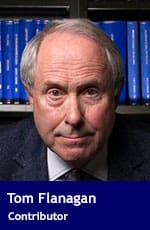
Tom Flanagan is a professor emeritus of political science at the University of Calgary and a Fellow of the Royal Society of Canada. He is a senior fellow at the Frontier Centre for Public Policy and co-editor of the best-selling book Grave Error: How the Media Misled Us (and the Truth about Residential Schools).
Explore more on Residential Schools, Coercive progressivism, Free speech
The views, opinions, and positions expressed by our columnists and contributors are solely their own and do not necessarily reflect those of our publication.
Troy Media empowers Canadian community news outlets by providing independent, insightful analysis and commentary. Our mission is to support local media in helping Canadians stay informed and engaged by delivering reliable content that strengthens community connections and deepens understanding across the country.

